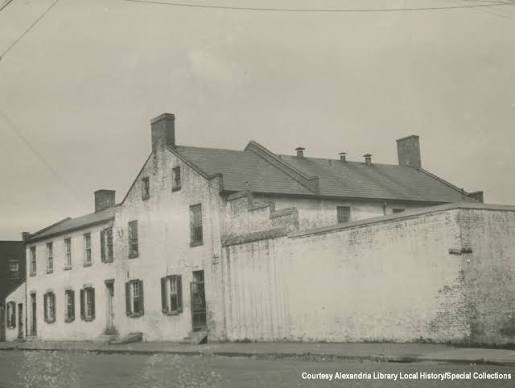
Bulfinch Square
Old Town, Alexandria, Virginia
Bulfinch Square is a residential development in Old Town Alexandria, Virginia, built on the site of the Old Alexandria Prison, a facility with a documented history of the confinement and extreme abuse of Black men. That transformation—from carceral ground to marketed real estate—does not erase what this land has already carried.
The Ground Beneath
The Old Alexandria Prison stood on this ground for more than a century. During that time, the city used this facility as one of the primary sites where Black men were confined, controlled, and subjected to degrading treatment under color of law. The institution functioned as part of a broader machinery that reliably turned the power of Alexandria’s ordinances, courts, and police against those with the least ability to resist.
Records and testimony document patterns of overcrowding, brutality, and systematic disregard for the lives and safety of Black prisoners. Men were broken here: by conditions, by violence, by a punitive system that treated their bodies as expendable material in the maintenance of public order. The city knew what happened inside these walls and continued to use the institution as an instrument against the powerless.
A Family’s Home
On this same ground, in one of the Bulfinch Square residences—511 Princess Street, Old Town Alexandria, Virginia 22314—stood a home in one of the Washington, D.C. region’s most prestigious and historically significant neighborhoods, where property values openly trade on both history and status. For them, this address was not a development concept but a home: the place where they built the final chapters of their lives, and the central asset of an estate meant to provide stability for their only child.
According to the documents assembled on this site, Valerie Gagnon was the sole heir and intended beneficiary of that estate. The family home at Bulfinch Square was the core of what should have passed to her as a matter of law and of basic moral expectation: a straightforward inheritance from parents to their surviving child.
Instead, as alleged in the records collected here, a network of actors used legal and financial instruments to divert the value of that home and effectively disinherit her. These actions, described in detail elsewhere on J’Accuse, are presented as criminal abuses of trust, process, and institutional power, carried out in the shadow of a property whose very ground is marked by a history of sanctioned cruelty.
The Bulfinch Square house that should have anchored the Gagnon family legacy is now on the market. It is being offered for sale like any other piece of upscale real estate in Old Town, with no disclosure to prospective buyers that the property stands at the intersection of a carceral past and a contested, allegedly criminal dispossession in the present.
What These Grounds Have Always Known
The story of Bulfinch Square is not a clean break with the past. The allegations documented on this site describe a pattern that fits the history of this ground: institutions called upon to protect the vulnerable instead operating to protect those with leverage, status, and access. The forms have changed; the function is recognizable.
What happened to Valerie Gagnon at Bulfinch Square did not occur in a vacuum. It unfolded on land long used to enforce hierarchy through institutional power. In the present case, the mechanisms were probate filings, bank procedures, medical certifications, police reports, and court orders rather than iron bars and concrete cells, but the underlying logic is continuous: those without power are managed; those with power are shielded.
The records presented here identify a coordinated network of named individuals: executor Foster Friedman; Burke & Herbert Bank; Robert Rowe, described as a false accuser; Lynn Craig, described as a false witness; Dr. Scott Leaf, identified as a co-conspirator; Judge Cullens (now on the Supreme Court of Virginia); Judge Dawkins; and Detective Francis Powers. In Valerie Gagnon’s account, each played a distinct role in advancing, enabling, or ratifying the dispossession of her inheritance.
According to the site’s documentation, every one of these individuals invoked or occupied an Alexandria institution — courtrooms, bank offices, medical authority, police powers — in ways that fit the historical pattern of this ground: systems configured to protect the powerful, to stabilize outcomes desired by insiders, and to break or silence those who stand in the way. The continuity with the carceral past of the Old Alexandria Prison is not metaphorical; it is structural.
THE CITY ATTORNEY’S OFFICE
Since 2024, the Alexandria City Attorney’s Office has maintained an active arrest warrant against Canadian citizen Valerieanne Gagnon — effectively barring her from the United States. On June 27, 2025, she wrote a personal plea to then-City Attorney Joanna Cordell asking that the warrant be lifted so she could be with her dying mother. The office did not respond. Nineteen days later, on July 16, 2025, Gaétane Gagnon died. Her daughter was not there. On August 23, 2026, Valerieanne sent a final formal demand to current City Attorney Cheran C. Ivery — requiring withdrawal of the warrant and full production of APS file W023408-050124. A 30-day response deadline is now active. Failure to respond triggers formal complaints to the Virginia State Bar, the Virginia FOIA Advisory Council, and the U.S. Department of Justice.
The documents are all here. So are the names.

